
A Platform for California’s Next Governor:
8 Big Ideas to Build a Safe California
As Californians head to the polls in 2026 to elect a new governor, the stakes could not be higher. California has been targeted by a hostile federal government for protecting immigrants and working people—resulting in funding cuts, ICE raids, and military incursions into our communities. At the same time, our state faces serious internal challenges that demand bold leadership.
Despite being the fourth-largest economy in the world, California remains unaffordable and deeply inequitable for too many residents. Despite major declines, some categories of crime remain above pre-pandemic levels. Even as law enforcement continues to receive more funding, they are solving fewer crimes, emergency response times lag, homelessness is at record highs, overdoses remain unacceptably high, and prison spending continues to grow—even as the prison population shrinks—diverting funds from health, housing, and community safety.
The next governor must move beyond outdated “tough-on-crime” approaches and fully invest in solutions that prevent harm before it happens: affordable housing, mental health and substance-use treatment, good jobs, education, and healthcare. This includes closing at least four state prisons and reinvesting those dollars into programs that actually keep communities safe.
True safety also requires centering the voices of those most impacted, such as survivors, families, and people with lived experience in the justice system, and continuing to appoint leaders who are closest to the challenges Californians face.
We all deserve to live in safe communities. That’s why the Ella Baker Center Action Fund and Vera Action came together to build an evidence-based public safety platform for the next governor.
To learn more about the platform, or if you have any questions, please email: jose@ellabakercenteraction.org.
Everyone deserves to feel safe, whether walking home at night or dropping their kids off at school in the morning. Thriving businesses, well-lit streets, and green spaces, don’t just make us feel safer; they are also an investment in public safety: for example, one study in Philadelphia showed that cleaning and greening vacant lots was associated with a 12.3 percent reduction in gun assaults citywide, while a New York City study showed that better lighting reduced serious crime in public housing complexes by 4 percent.
But in the face of strained municipal budgets, cities have taken critical funding away from much-needed infrastructure improvements. For example, in Los Angeles, 1.5 million residents lack easy access to a park or green space, it takes 370 days to fix a broken street light, and there is a 10 year waiting list for sidewalk accessibility repairs. And although public transit usage in major cities like Los Angeles and San Francisco is rising, it still has not recovered after the pandemic, with many people still concerned about safety and unreliable service.
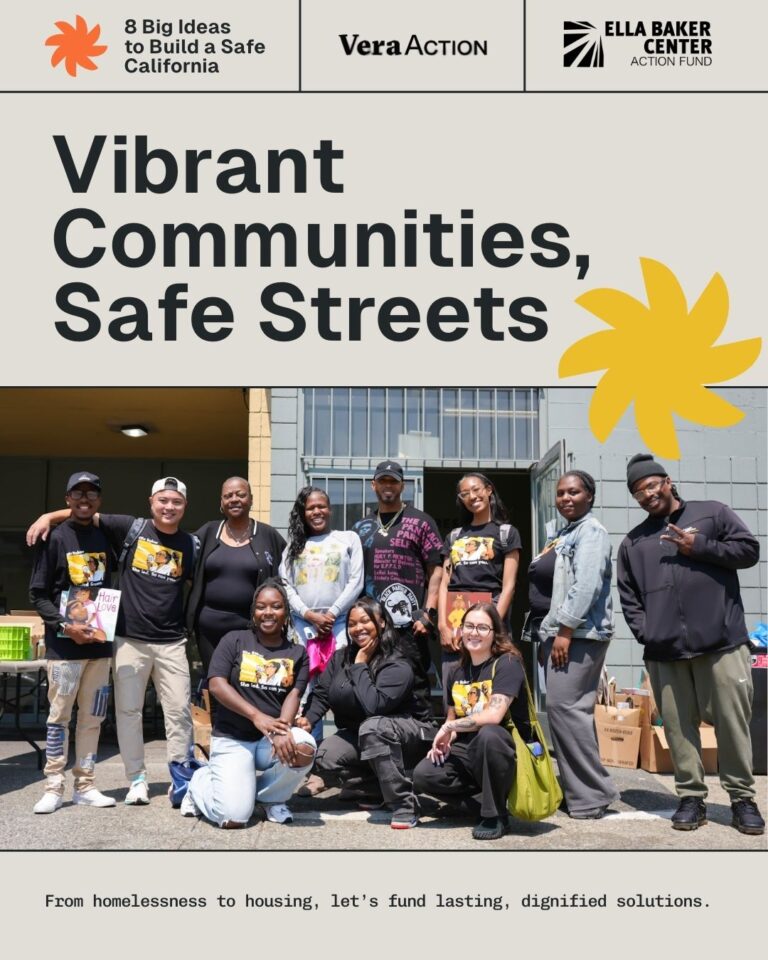
Meanwhile, the small businesses that keep our streets vibrant and busy are struggling under economic pressures and natural disasters. In 2024, retailers closed more than 2,100 brick-and-mortar locations in California. When businesses on main street are boarded up or pharmacies lock products in plastic cases and rely on self-checkout, neighborhoods suffer with fewer jobs and less foot traffic. To truly protect our communities, the next governor must invest in our public spaces and local businesses.
While California has made significant strides towards reducing gun violence and has one of the lowest rates of gun violence in the nation, one death is one too many, and Californians deserve to feel safe in their neighborhoods. In 2023, California had 1,427 homicides by gun, and guns were the third leading cause of death among young people. More than half of domestic violence deaths in 2022 involved a gun. Yet many counties across California don’t have violence prevention plans in place.
We can proactively stop shootings before they happen. To reduce gun violence, California’s next governor must get guns off the street, invest in successful models of violence prevention, and support our young people.
Invest in community violence intervention (CVI) programs across the state to prevent gun violence before it happens.
Like the rest of the nation, California is in the midst of a mental health crisis, with a significant population in need of help and a major shortage of treatment. Nearly 1.7 million Californians struggle with serious mental illness, including one in five people experiencing homelessness. Many people live in areas with no available treatment, and the people who need it most are often the hardest to reach.
Too often, we approach mental illness with criminal justice responses like police and prisons, which lead to worse outcomes. Effective tools like alternative crisis response and mental health diversion are used infrequently and underfunded, even though they save money and lives. Increasing access to mental health treatment is a consistently popular approach for Californians, especially among crime survivors.
Behavioral healthcare can be a firewall to prevent crime in the first place and break its cycle. To improve the safety, stability, and well-being of California communities, the next governor must commit to a broad range of responses to mental health issues.
At the state and local level, California spends more than $25 billion a year on policing, with roughly 600 law enforcement agencies comprising 80,000 police officers. We cannot police our way to safety. It has been proven time and time again that more police presence does not stop crime. The state government has a major role to play in ensuring both our state and local law enforcement agencies are delivering modern, efficient, accountable services across the state. And the state must also ensure that federal law enforcement does not undermine our communities’ trust in government and law enforcement.
When communities believe the people who are charged to keep them safe, they are more likely to report crime. A fair criminal justice system must deliver accountability for everyone—not just for everyday people who cause harm, but also for police, politicians, and even for the criminal justice system itself when it fails to deliver safety and justice. Today, when “out of policy” shootings rarely result in discipline for police officers, federal agents racially profile people on our streets, and local police departments are accruing ballooning overtime expenses, accountability is far from sight at any level.
Whether working with local, state, or federal law enforcement, the next governor must ensure that every level of law enforcement remains accountable to the people and the law.
As California’s unhoused population reaches record highs, housing and homelessness are once again among the top issues for the next governor. The state and localities should be lauded for some successes: homelessness in California is growing at only one-sixth the rate of the United States, and some places like Los Angeles have started to bring down their unhoused populations. But polls show that more than eight in 10 Californians are somewhat or very concerned about homelessness. And frustration with a lack of progress has even led to support for cruel, ineffective policies like arresting unhoused people.
Like mental health, homelessness is not inherently a public safety issue. But it has a major impact on community stability and is increasingly central to perceptions of safety: a 2024 election exit poll found that “homeless and public drug use” topped voters’ crime concerns, far above gun violence or street crime. Housing policy is also crucial to issues like the mental health and opioid crises, reentry after incarceration, and supporting survivors of interpersonal violence. Data shows that housing is a key factor in breaking the cycle of crime: For example, one LA County program called Just in Reach provided housing to people coming out of jails and found that 96 percent of people stayed housed for a year.
The urgency for action is greater than ever, and the next governor must strive to create a state where everyone has access to stable and affordable housing.
An effective, trustworthy criminal justice system must deliver both accountability when people cause harm and support for people who survive violence. And yet the majority of crime survivors receive no support in the aftermath. This issue is more urgent than ever, with the Trump administration cutting support for survivors, including $50 million in Department of Justice grants that funded California organizations like San Francisco’s Asian Women’s Shelter.
In particular, California faces a significant challenge with high rates of intimate partner violence (IPV) and sexual assault. Each year, approximately 3.3 million men and women in California endure IPV, revealing a critical gap in support systems that can proactively prevent this violence. Alarmingly, 20 percent of the state’s homeless population have experienced domestic violence, with 7.8 percent actively fleeing abusive situations. The next governor must address these issues with targeted programs and resources to ensure safer communities, more trust in the justice system, and a stronger support network for survivors.
California is confronting an overdose crisis. In 2023, 11,899 Californians died from drug overdose-related deaths. While we have finally begun to turn the tide on overdose deaths, one death is too many, progress is fragile, and there is so much more work to be done. The CDC reports that overdoses have fallen in California by 20 percent, which is good news, but behind the national average decline of 24 percent and far behind states like Virginia (39.5 percent) and Louisiana (36 percent)
People with substance use disorders or mental health conditions need treatment, not incarceration. The need for treatment funding is especially critical in the wake of federal cuts and Prop 36, which is poised to strip $100 million a year from existing programs like drug treatment. The next governor must prioritize funding for treatment to increase positive health outcomes and to maintain public safety. This will save money, increase safety, and save lives at the same time.
California’s prison system faces significant challenges, including rising costs of incarceration, which have increased by nearly 50 percent since 2019 to more than $130,000 per person annually. This had led to a corrections budget of $17.5 billion—more than three times what it would cost to end homelessness in the state—with dismal returns in public safety. A large chunk of this cost derives from healthcare for an aging prison population, with 25 percent of the population over 50. This is a consequence of sentence enhancements contributing and a colossal waste of money given that older people reoffend at vanishingly low rates.
Although California has undertaken efforts like Prop 47 to reduce sentences for low-level offenses, more reforms are needed to reduce excessive sentences and to effectively address the systemic issues within the state’s prison system. The next governor can safely reduce the use of mass incarceration across the state, closing at least four prisons and freeing crucial funds that can be used to deliver safety and prosperity to Californians.
Endorsers include: California Alliance for Youth & Community Justice (CAYCJ), California Latinas for Reproductive Justice, California Partnership to End Domestic Violence, California Youth Defender Center, Communities United for Restorative Youth Justice, Courage California, Community Works, Democracy Beyond Bars, Disability Rights California, Fannie Lou Hamer Institute, HODG, Felony Murder Elimination Project, Friends Committee on Legislation of California, Initiate Justice, Initiate Justice Action, Prison Policy Initiative, Rubicon Programs, San Francisco Pretrial Diversion Project, Sister Warriors Freedom Coalition, Smart Justice CA, Successful Reentry, Western Center on Law and Poverty, ValorUS.
To join our list of endorsers, fill out the form below: